



BRGHTGOV

From dialogue to decision — at scale. Built in the open for the public good.

↓ scroll

Every vote auditable by all, manipulable by none.

eGovernance + CivicTechLab

We invite civic innovators, technologists, and policymakers to collaborate and innovate together. While voting online makes collective deliberation fast and efficient, every voice becomes a verifiable vote — and the final tally, a number that reflects a shared will. Our systems support multiple voting models: Condorcet, Ranked Choice, or 1-Person-1-Vote, to name a few.

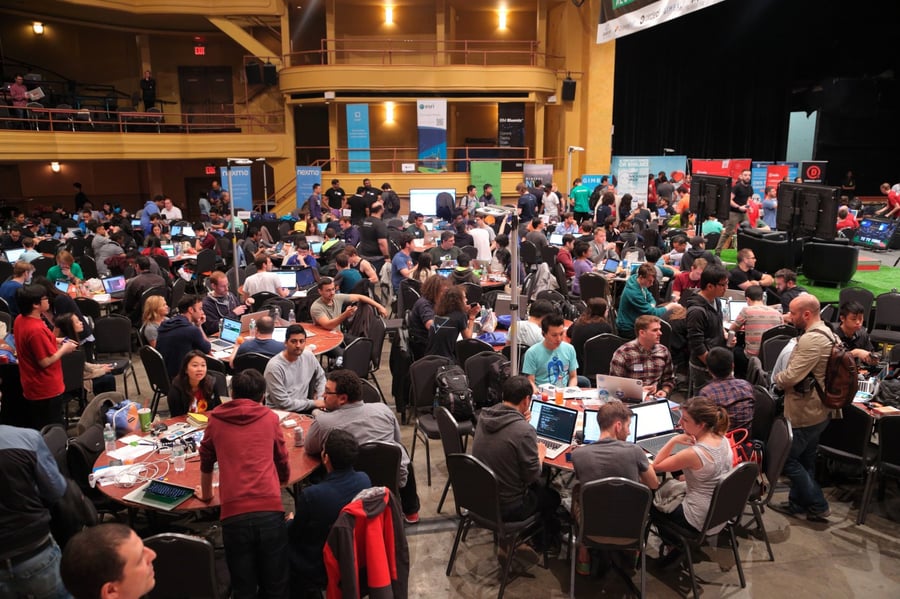
people meeting in room digital voting interface
What we do
"The unreasonable man persists"
Online Voting Blockchain Security Cooperative Frameworks Coordination Tools Assembly Facilitation

Online Voting

End-to-end verifiable voting — every vote securely cast, accurately recorded, and auditable without compromising privacy. As trustworthy as paper ballots, at digital speed.

Blockchain Security

Tamper-proof, transparent records shared across institutions and citizens — smart contracts automate verification and cut corruption risk. Voting is the headline use case, not the only one.

Cooperative Frameworks

Tokenized incentives and reputation systems that reward real contributions and let proposals be evaluated and executed transparently — no centralized gatekeeper required.

Coordination Tools

Smart scheduling, structured chat, breakout rooms — digital infrastructure that lets people collaborate asynchronously or live, without losing the thread.

Assembly Facilitation

Expert moderation, logistics, and outreach so deliberation stays inclusive and focused — from citizen assemblies in person to fully virtual ones.

Portfolio

No single "ideal" partner — we work with anyone eager to explore new governance, foster participation, and strengthen democratic practice.

NFT / Web3 Gaming

Corrupted Pigs

An NFT card game where collectors access mini-games and staking activity — proceeds from burning NFTs go to social causes.

  • Gamification of DAO governance aligned with brand ethos
  • Online voting implemented during live gaming sessions
Cooperative / Civic

Uma Boa Questão

A Portuguese cooperative of artists, educators and social entrepreneurs, working across art, culture and education, with strong ties to the hip hop movement.

  • Citizen Assembly-style deliberation, facilitated end-to-end
  • Blockchain-based i-voting layered on top

Research & Development

See all →

A civic research repository at the intersection of social sciences, political systems, technology and psychology — BrightGov's knowledge base.

RESEARCH & DEVELOPMENT

Arcada

When Artificial Intelligence translates the language of government.

Amiar · 7/17/2026 · 4 min read
RESEARCH & DEVELOPMENT

omeuvoto.com & votacoes.pt

Two independent platforms bringing citizens closer to Portuguese democracy.

7/9/2026 · 5 min read
RESEARCH & DEVELOPMENT

peticaopublica.com & participacao.parlamento.pt

Online petition platforms as tools for citizen participation.

4/21/2026 · 4 min read
RESEARCH & DEVELOPMENT

VotoAberto.org

A case study in operational transparency within representative democracy.

4/20/2026 · 3 min read
RESEARCH & DEVELOPMENT

analisa.pt

Public data aggregator and cross-referencing — from public contracts to local indicators.

4/20/2026 · 3 min read
RESEARCH & DEVELOPMENT

api.ptdata.org

Unified Portuguese Government Open Data API.

4/13/2026 · 3 min read

Civic Initiatives

See all →

Nine projects and sub-brands BrightGov runs or incubates — spanning policy, media, gaming and civic experiments.

The Council of the Commons
Petition

The Council of the Commons

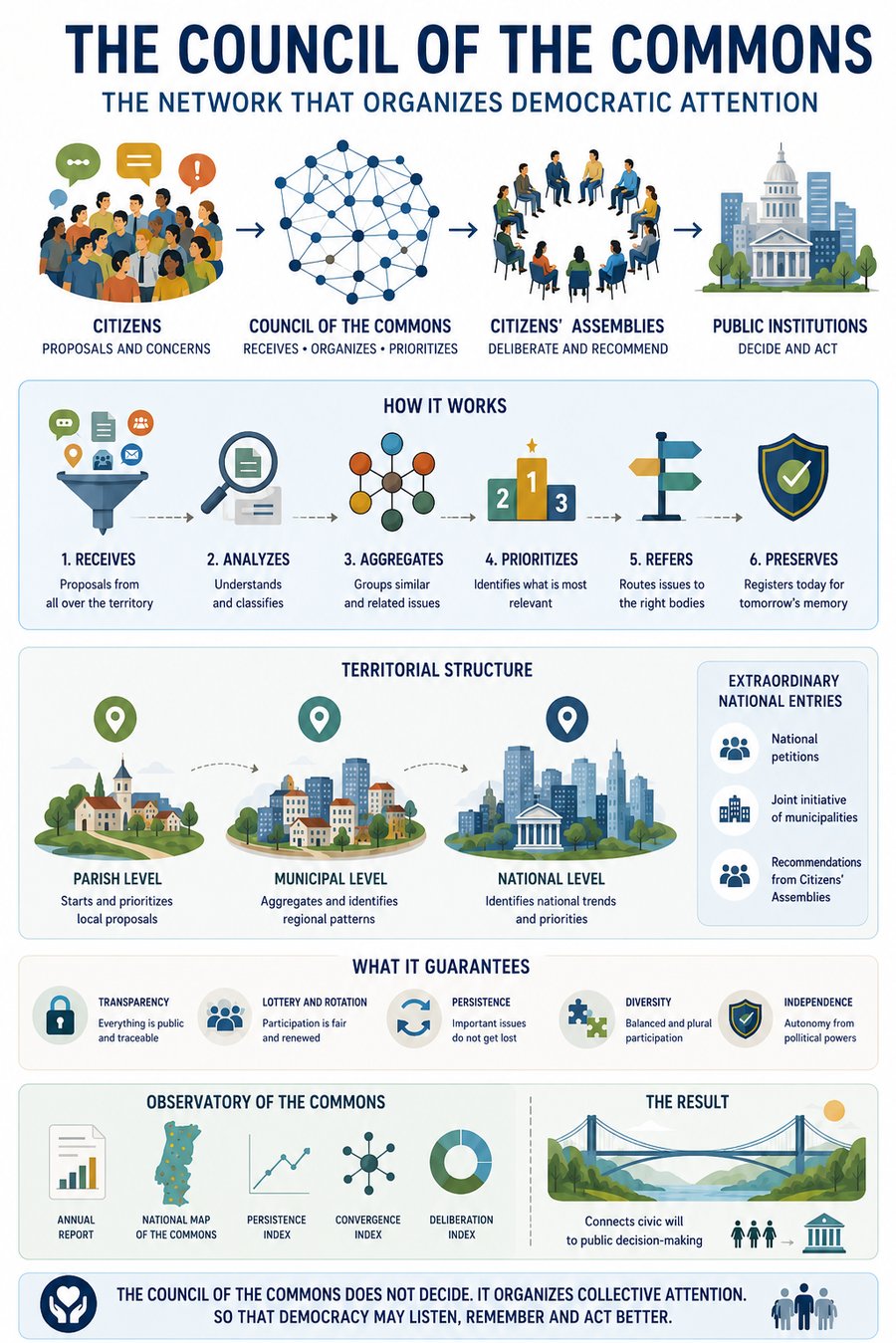
A formal proposal for a permanent civic institution that collects, aggregates and preserves public concerns — feeding Citizens' Assemblies without replacing them.

Full breakdown ↓
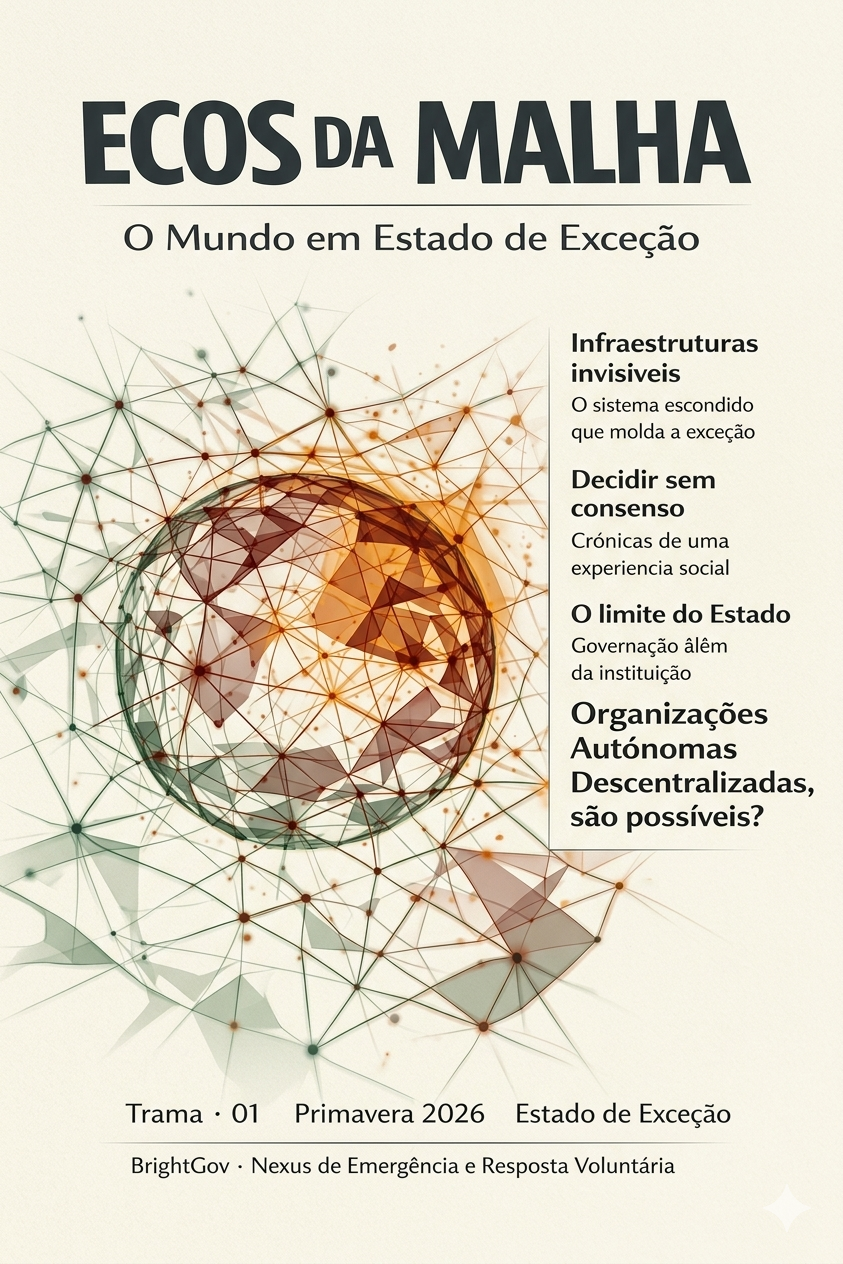
Echoes of the Mesh magazine mock-up
Editorial

Echoes of the Mesh

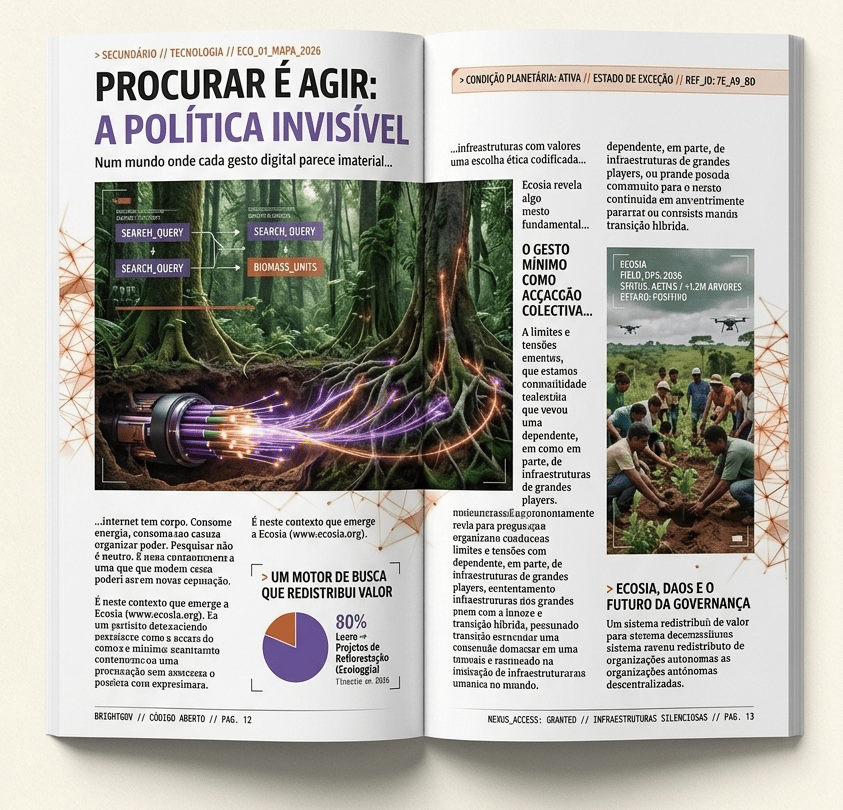
"Ecos da Malha" — a planned editorial platform on digital democracy, GovTech and decentralized governance. Currently a concept mock-up.

Full breakdown ↓
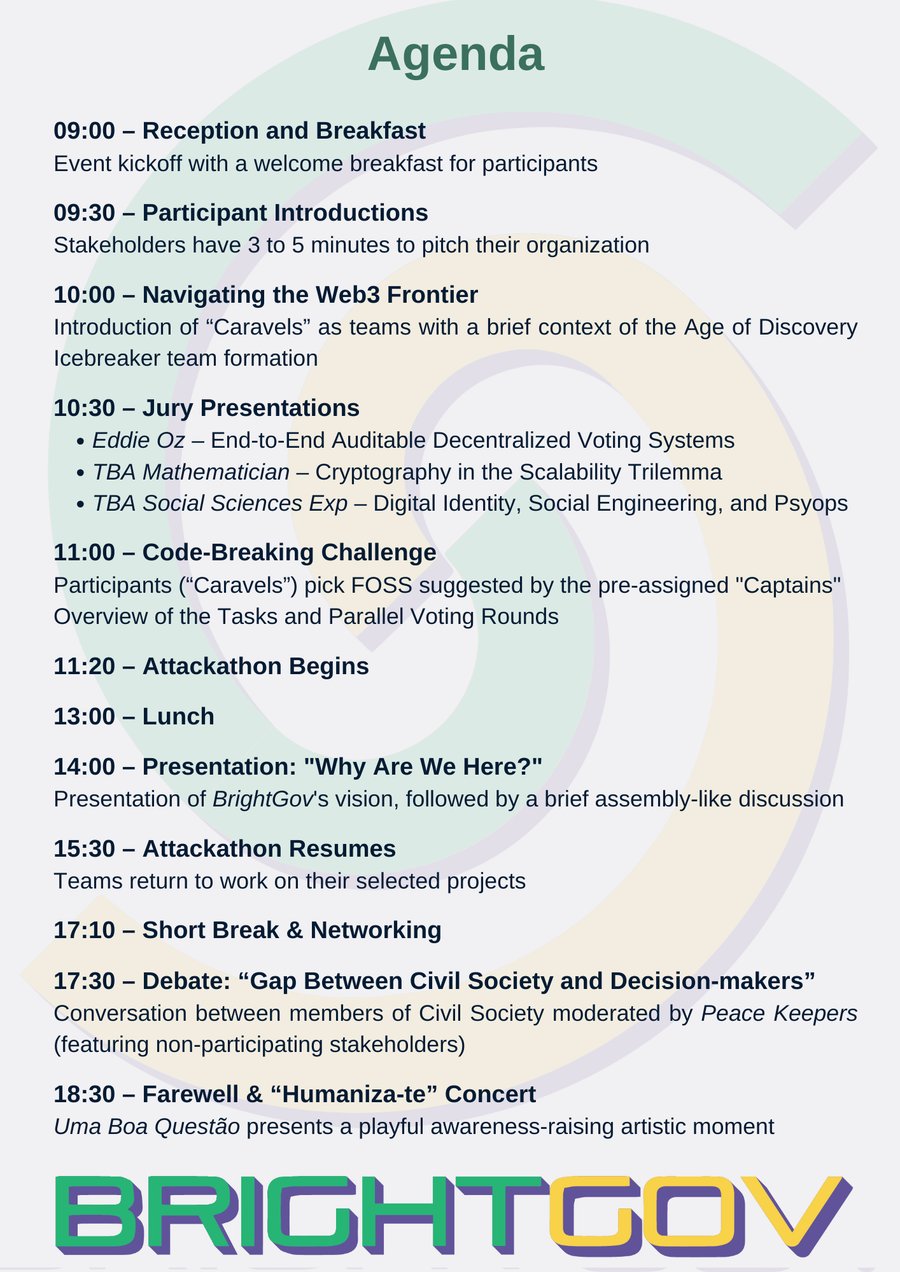
Voting Attackathon event
Event

Voting Attackathon

A hands-on security-testing event for online voting systems. First edition ran at Instituto Pedro Nunes with a Vocdoni expert.

Full breakdown ↓
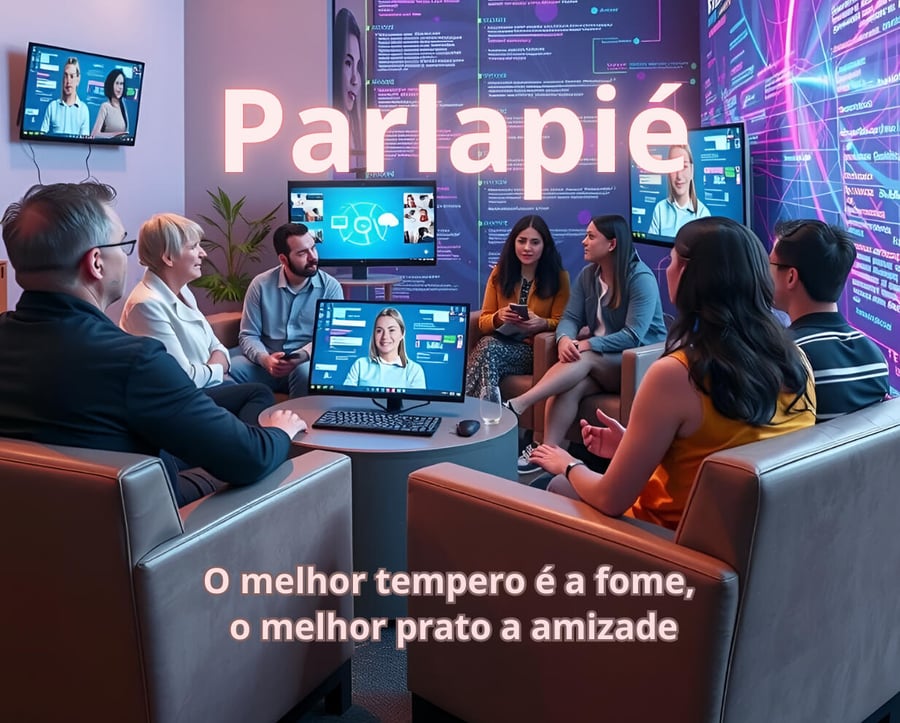
Parlapié on X Spaces
Deliberation

Parlapié

Structured deliberation run live on X Spaces — adapts citizens'-assembly fairness to social media, linked to Uma Boa Questão.

Full breakdown ↓
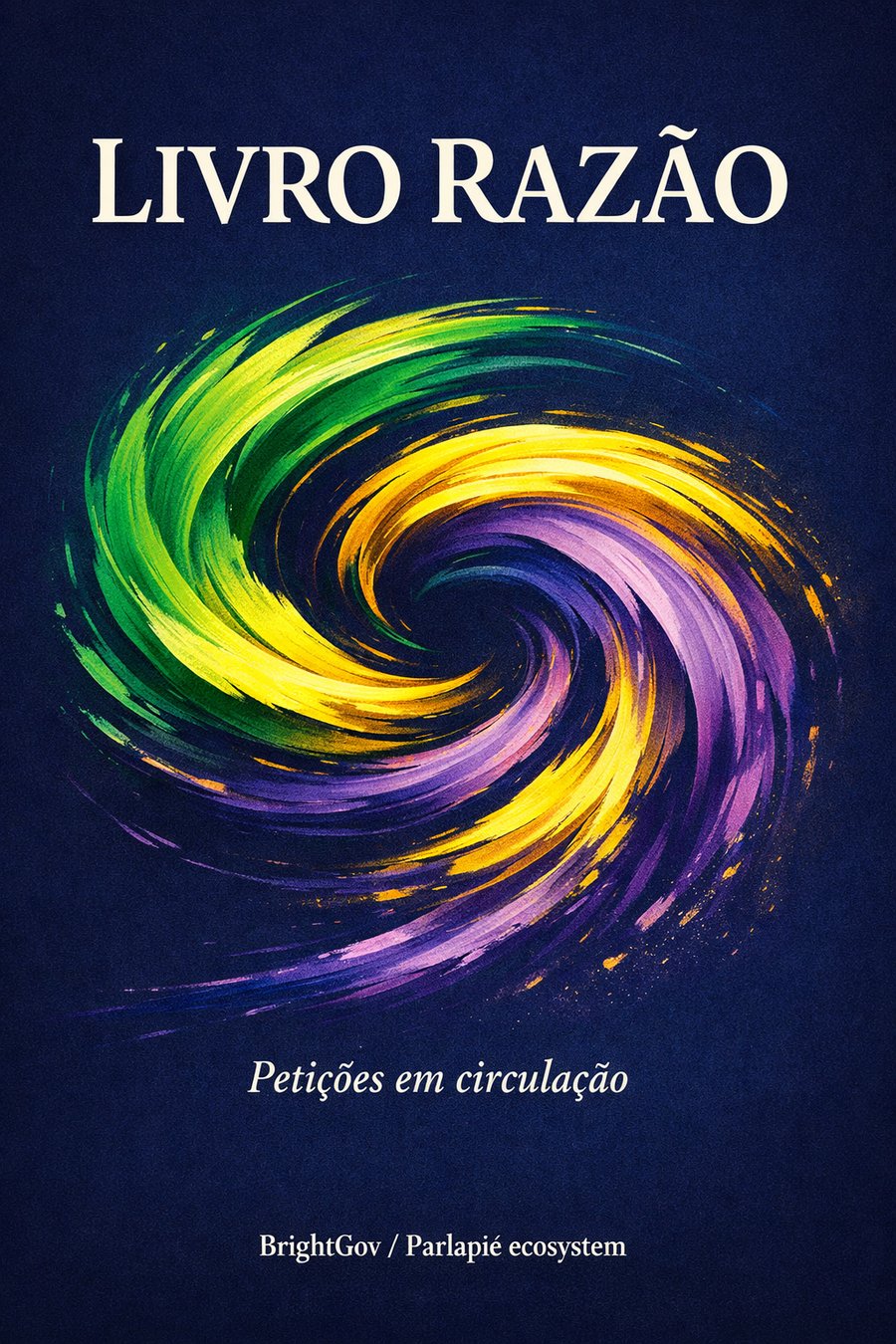
Livro Razão cover
Archive

Livro Razão

A book and living archive of petitions born out of Parlapié. 7 petitions endorsed so far (see below).

Full breakdown ↓
Tesserae of Democracy mosaic concept
Art / Civic

Tesserae of Democracy

Individual portraits + collective votes become a photographic mosaic — every participant becomes a "tessera."

Full breakdown ↓
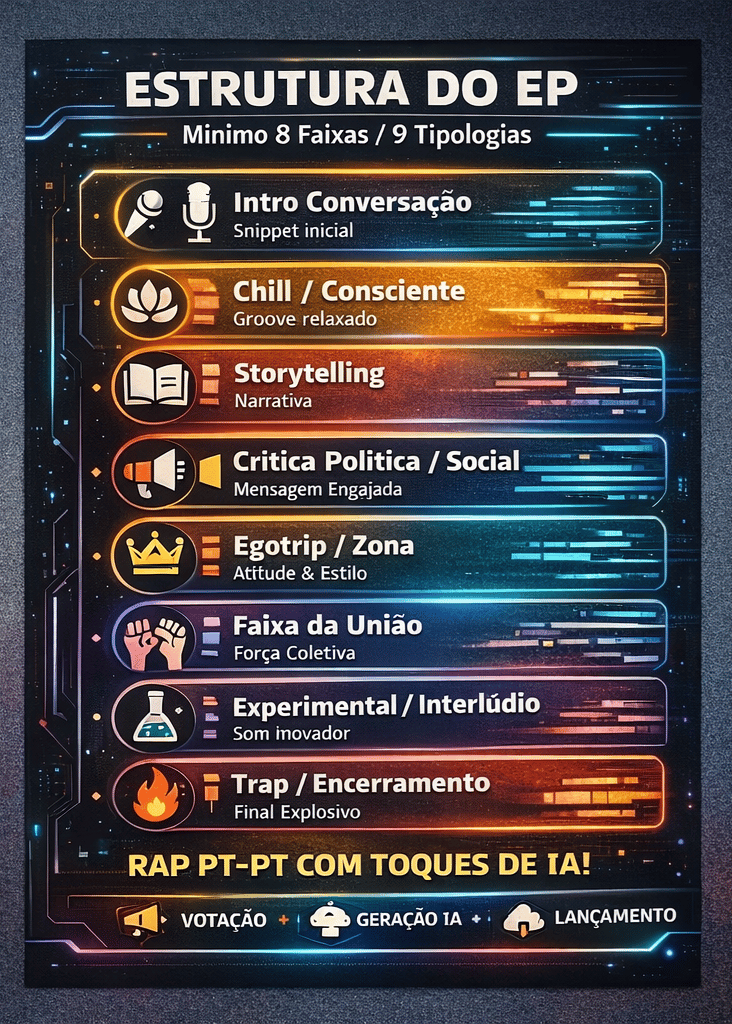
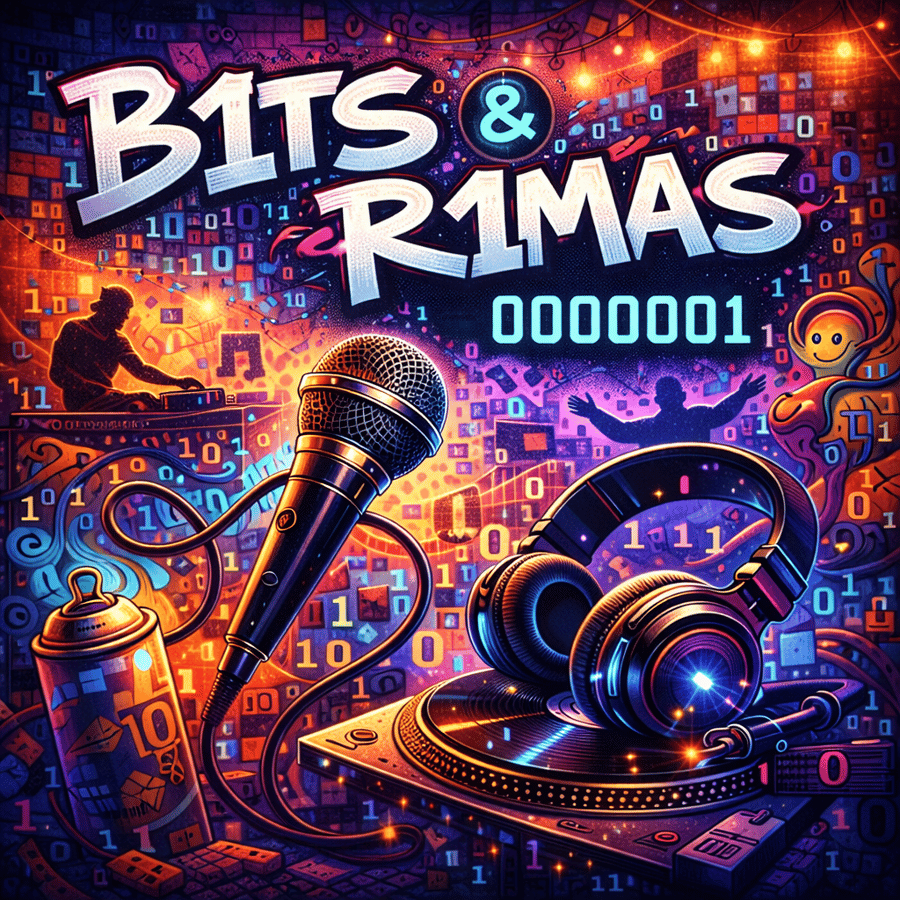
B1ts & R1m4s cover art
AI / Music

B1ts & R1m4s

A weekly archive of AI-generated EPs, filtered by collective online voting before release.

Full breakdown ↓
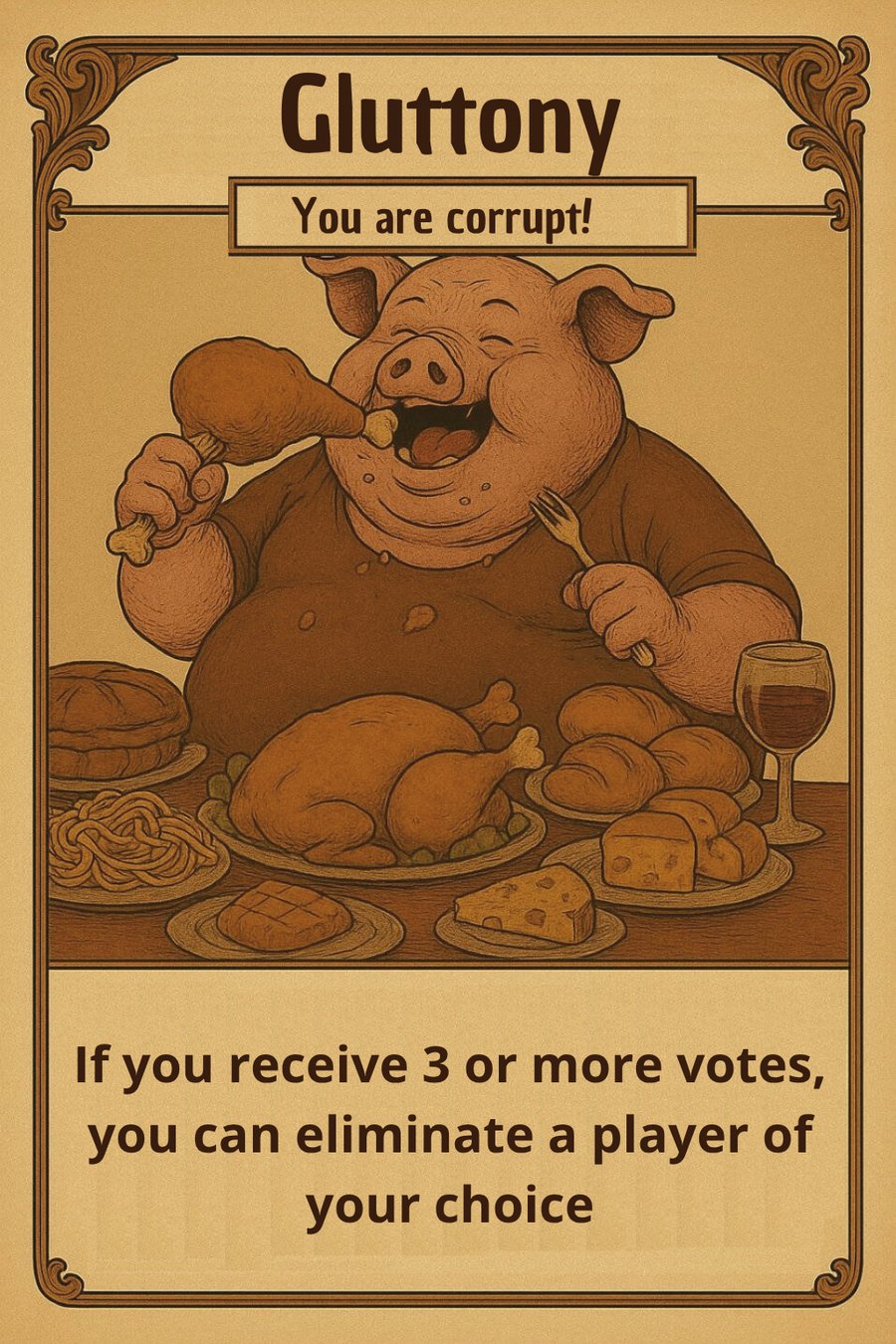
It's Not a Pig's Fault game art
Game — CPigs

It's Not a Pig's Fault

A social-deduction game in the Corrupted Pigs universe — voting is the core mechanic. Confirms CPigs as a sister project.

Full breakdown ↓
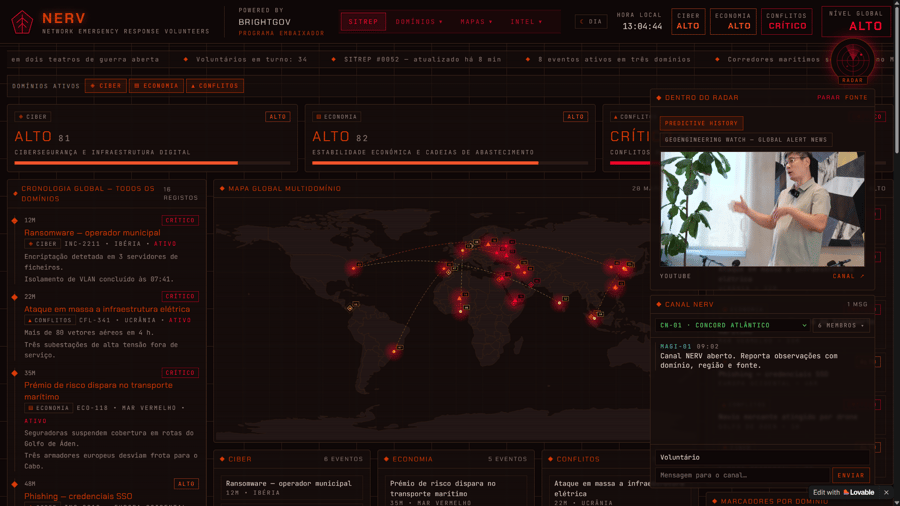
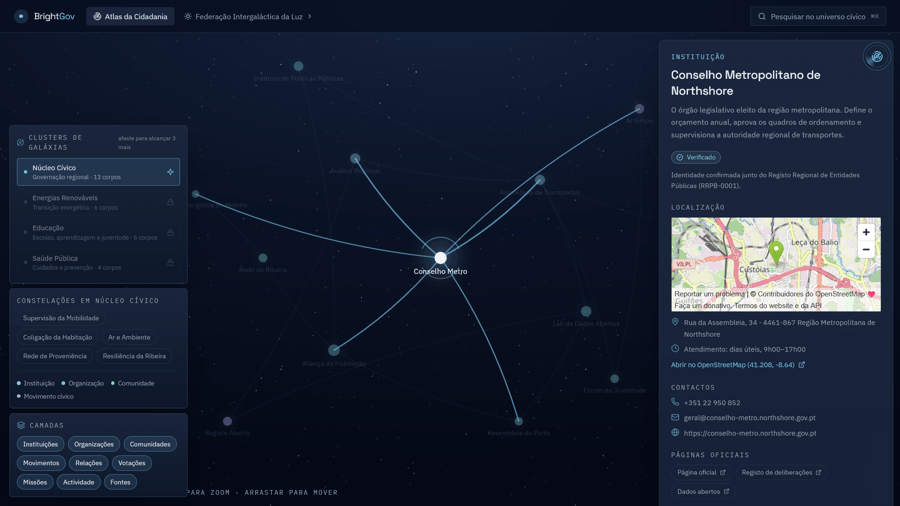
Ambassador Program dashboard
Program

Ambassador Program

Two interfaces that gamify civic participation: Citizenship Atlas and NERV, a civic-intelligence dashboard.

Full breakdown ↓

Livro Razão — Endorsed Petitions

Nuremberg 2.0 — For Truth, Justice, Reparation and Non-Repetition8/20/2026
The Council of the Commons7/20/2026
Reform of the United Nations Security Council5/2/2026
Public Money, Public Code4/24/2026
Institutionalization of Citizens' Assemblies4/22/2026
Migration and Border Control Policy4/21/2026
Direct Democracy Through Local Referendums4/13/2026

Each Initiative, in Full

Petition · brightgov.tech/the-council-of-the-commons

The Council of the Commons — A Permanent Infrastructure for Democratic Attention

Addressed formally to the Government of Portugal, the Assembly of the Republic, the National Association of Portuguese Municipalities, the National Association of Civil Parishes, and citizens at large, this petition argues that modern democracies have participatory mechanisms — petitions, consultations, assemblies — but no permanent institution dedicated to continuously observing, organizing and remembering the concerns society keeps raising. Issues surface, get attention for a news cycle, then vanish before anyone acts on them.

The proposed Council is explicitly not a parliament, government, court, Citizens' Assembly, or any legislative/executive/judicial body. It exercises no authority and replaces nothing that exists — its only job is making sure no democratically relevant signal disappears for lack of institutional memory. It answers "what should we deliberate about"; existing Citizens' Assemblies keep answering "what should we do."
  • Parish level — receives, registers and locally aggregates proposals from citizens, groups, petitions, associations and informal movements. The main entry point into the whole system.
  • Municipal level — purely interpretative, no agenda-setting power of its own: identifies territorial patterns across parishes and refers upward.
  • National level — also interpretative, not executive: aggregates nationally, spots systemic trends, prepares reports, and refers matters to Citizens' Assemblies and public institutions. National petitions above a threshold, joint initiatives from several municipalities, or a Citizens' Assembly recommendation can also enter directly at this level.

Every proposal lives permanently in a Public Register of the Commons — origin, history, related aggregations, priority status, current stage. Nothing is ever deleted, only marked under review, aggregated, prioritized, referred, deliberated, archived or reactivated. Members of the Council itself would be chosen by civic sortition (lottery), serving fixed non-renewable terms, to guard against capture.

To stop the agenda being dominated by whatever is loudest this week, prioritization is explicitly split: 60% by public relevance, 20% by how long an issue has persisted, and 20% decided by civic lottery among eligible proposals. A companion "Observatory of the Commons" would publish an annual report, a national map of concerns, and indices tracking democratic persistence, territorial convergence and how effectively deliberation actually happens.

Read and sign the full petition →
Editorial · brightgov.tech/echoes-of-the-mesh

Echoes of the Mesh — "Ecos da Malha"

BrightGov's planned editorial initiative, pitched as more collaborative knowledge platform than magazine: a space where researchers, public institutions, civic innovators, entrepreneurs and community leaders share ideas and practical solutions for the future of democratic participation.

Planned formats include articles, interviews, case studies, opinion pieces and original research, covering digital democracy, GovTech, CivicTech, artificial intelligence, blockchain, digital identity, online voting, transparency, public innovation and decentralized governance. The stated goal is connecting academic research to real-world implementation — making governance challenges legible enough that more people engage with them, not fewer. Today it exists as a cover and layout mock-up, not yet a running publication.

See the original page →
Event · brightgov.tech/voting-attackathon

Voting Attackathon

Framed under what the team calls "Cybersecurity Rule #6": trust is something you give, not something taken or imposed. The Attackathon puts that literally into practice — a hands-on event where security researchers and critical voices are invited to actually try to break an online voting system, in the open, before it ever handles a real election.

The first edition ran at the facilities of Instituto Pedro Nunes, bringing together a small group — but, in the team's own words, "the right group": a senior expert from Vocdoni among them. The stated takeaway is that impact isn't only measured in headcount; the quality of the conversation carried the event. The stated ambition is to turn this into a repeatable, standard practice for the sector — an annual stress-test culture around voting security rather than a one-off. The page also keeps an open call for partners, hosts and sponsors for future editions.

See the original page →
Deliberation · brightgov.tech/parlapie

Parlapié — Networked Experiments

Parlapié started informally, out of open conversations in X (Twitter) Spaces with the Portuguese community — everyone got a chance to speak on whatever topic came up. Over time the organizers noticed the same debates kept repeating, so the format was tightened: topics stopped recycling, and something closer to real consensus started to emerge.

Mechanically, it adapts core citizens'-assembly principles — structured dialogue, equal opportunity to speak, collective reasoning — to a live, voice-driven social platform: speaking time is time-limited, and participants who haven't spoken yet are prioritized, specifically to counter the asymmetry of open-mic formats where the loudest or most followed voices dominate. The team frames X Spaces itself as valuable precisely because social platforms already pull together a broad, heterogeneous sample of people across background, profession, sex and age — closer to a real cross-section than a self-selected civic-tech crowd. To join, you only need an X account and to follow Uma Boa Questão.

See the original page →
Archive · brightgov.tech/livro-razao

Livro Razão

Livro Razão ("Book of Reason"/ledger) is both a physical book and a living archive — petitions and political writings that grew directly out of Parlapié's conversations, bringing together proposals, civic interventions and institutional critique shaped by its author's political vision.

The project deliberately sits between public policy, digital democracy and speculative statecraft. It's described as functioning less like a conventional legal compilation and more like an archive of political imagination — a written ledger of demands, systems and ideas addressed directly at the structures of power, challenging the conventions of bureaucratic language along the way. Seven petitions are endorsed under it so far (full list above), spanning topics from historical accountability (Nuremberg 2.0) to local direct democracy (Swiss-style municipal referendums).

See the original page →
Art / Civic · brightgov.tech/tesserae-of-democracy

Tesserae of Democracy

An idea that treats civic participation as raw material for a portrait: individual portraits plus collective votes become one photographic mosaic — a political photographic mosaic, in the project's own phrasing — giving visual, physical form to a group decision that would otherwise just be a number in a report.

Participants take part through whatever democratic mechanism fits the specific work — signing a petition by hand, voting in an online consultation, joining a public deliberation. After taking part, each person is photographed and becomes a "tessera": literally, one tile of a mosaic. Hundreds of individual portraits then assemble into a single larger composition, so the final image is made, quite literally, of the people who expressed that particular collective will.

See the original page →
AI / Music · brightgov.tech/b1ts-and-r1m4s

B1ts & R1m4s

Instead of a traditional album, B1ts & R1m4s operates as an evolving archive of weekly, numbered EPs. Each release is built from a large pool of AI-generated tracks — but the project's own framing is explicit that the interesting part isn't the generation itself, it's the selection.

Every week, the AI produces a high volume of tracks across different styles. A diverse collective of participants then listens and votes online for the material they think is best, judged on coherence, impact and relevance to the moment — deciding, collectively, what actually makes it onto that week's EP. The result is a growing discography where each release doubles as a snapshot of human editorial judgment filtering machine output, rather than a single artist's voice.

See the original page →
Game — CPigs · brightgov.tech/its-not-the-pigs-fault

It's Not a Pig's Fault

A social-deduction game set in the Corrupted Pigs (CPigs) universe, openly modeled on classics like Werewolf and Mafia. Players are secretly split into two factions: the Pure, trying to expose corruption, and the Corrupt, infiltrating the community while hiding their identity and eliminating opponents.

Each round mixes discussion, deception and strategic reasoning — any statement can be a genuine clue or a manipulation, and every player has to decide who to trust. At the end of a round, the group votes on who gets eliminated: because every vote carries equal weight, influence comes from argument rather than authority, and a single well-argued (or badly-argued) vote can swing the match. The game exists explicitly as CPigs' side of the same coin BrightGov works on directly — BrightGov builds the real infrastructure for trustworthy digital voting; CPigs explores the same themes of trust, accountability and corruption through games and storytelling, confirming it as a sister project rather than a client relationship.

See the original page →
Program · brightgov.tech/ambassador-program

Ambassador Program

The Ambassador Program combines two complementary interfaces that, in BrightGov's own description, "gamify politics." Citizenship Atlas is a living map of the organizations, institutions and communities that shape democratic life. NERV — Network Emergency Response Volunteers — is a civic-intelligence dashboard tracking emerging issues, signals and collective action across society as they happen.

Ambassadors themselves represent the organization and are responsible for actually delivering the services BrightGov lists — they're described as founders and community stewards, not staff. According to the program's own FAQ, the goal is to defend and spread democratic values where they're needed most; once fully launched, ambassadors would explore governance across different DAOs, spread democratic practice into organizations outside the Web3 bubble, and host events like the Voting Attackathon. Anyone is immediately accepted, but progresses through roles — Navigator to Activist, Citizen to Ambassador — as they take on real challenges. The program is currently going through R&D "due to complexity," per the site's own FAQ, rather than fully live.

Open Citizenship Atlas → Open NERV →

BrightGov's Ambassadors

Ambassadors represent the organization and are responsible for providing the services listed. They're founders and community stewards.

Nuno Chainho Amiar

Nuno Chainho Amiar

Ambassador
"Platforms of the future are to be cybersecure, censorship resistant and respect privacy."
Abdelmoumen Lahmidi

Abdelmoumen Lahmidi

Ambassador
"All progress depends on the unreasonable man." — quoting G. B. Shaw
Tiago Oliveira de Botto Quintans

Tiago O. de Botto Quintans

Ambassador
"It's not a question of voting or governing, but of being an active citizen."
Daniel A. N. Silva

Daniel A. N. Silva

Ambassador
"Verifiable online voting is the signature of the collective consciousness — auditable by all, manipulable by none."

FAQ

What is BrightGov?

A Civic/GovTech startup enhancing democratic participation — combining assembly facilitation, digital tools and blockchain-based solutions for transparent, inclusive decision-making.

Who can work with BrightGov?

Communities, organizations and initiatives that value participation, experimentation and open leadership, regardless of size or sector.

What services does BrightGov offer?

Two main tracks: Assembly Facilitation (guiding deliberations and citizen assemblies) and Tech Implementation (online voting systems, smart contracts, gamified governance).

How does BrightGov use technology?

Blockchain, smart contracts and interactive systems, built for secure, transparent and engaging decision-making.

What makes BrightGov different?

It combines participatory facilitation with digital technology — governance that's transparent, engaging and adaptable to different communities.

Backed by / Portfolio
Thendor Uma Boa Questão Corrupted Pigs
BUILT IN THE OPEN FOR THE PUBLIC GOOD END-TO-END VERIFIABLE · CRYPTOGRAPHIC SAFEGUARDS · STRONG IDENTITY CONTROL BUILT IN THE OPEN FOR THE PUBLIC GOOD END-TO-END VERIFIABLE · CRYPTOGRAPHIC SAFEGUARDS · STRONG IDENTITY CONTROL